
NEWS
Sowore: Joshua’s Fatal Crash Exposes Nigeria’s Systemic Rot
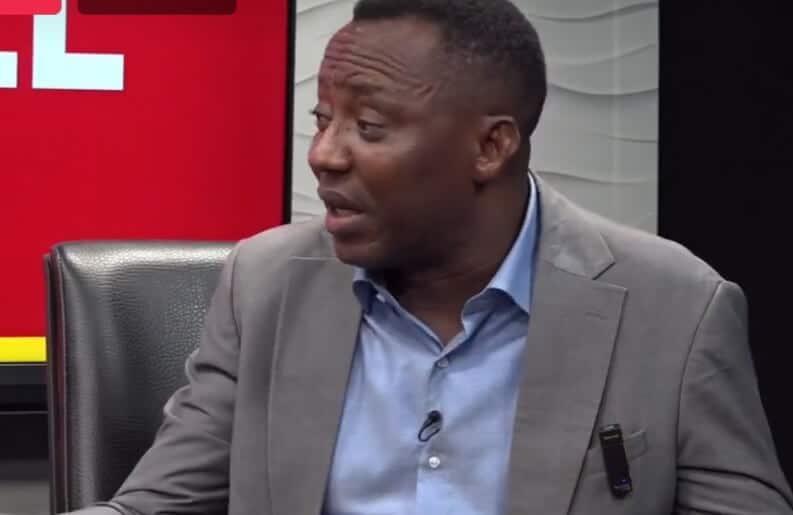
The tragic road accident involving former world heavyweight boxing champion Anthony Joshua has sparked a fierce national debate, moving beyond the survival of a sports icon to the grim realities of Nigeria’s public infrastructure. Human rights activist and former presidential candidate Omoyele Sowore led the charge this Tuesday, issuing a scathing critique of the country’s institutional failures. Writing on his verified X handle, the African Action Congress (AAC) leader argued that the incident is a microcosm of a nation that has failed to protect its most vulnerable citizens.
While the world breathed a sigh of relief at news of Joshua’s survival, the crash claimed the lives of several of his close associates. Sowore was quick to pivot the focus from the celebrity survivor to the victims whose lives were cut short. He warned against the tendency of the public and the media to treat the deceased as mere “footnotes” in a story dominated by fame. For the activist, the loss of life is not just a personal tragedy for the families involved, but a loud indictment of a government that has neglected the basic tenets of public safety.
Sowore’s commentary painted a harrowing picture of what he described as the “daily, naked reality” for millions of Nigerians who navigate the country’s treacherous road networks. He contended that the accident should serve as a moment of national reflection rather than a sensationalized news cycle. The tragedy, in his view, was not an isolated stroke of bad luck but a predictable outcome in a society where the systems meant to preserve life are either non-existent or fundamentally broken.
The activist leveled specific accusations at the nation’s emergency response agencies, including the police and road safety authorities. He pointed to a catastrophic lack of basic medical equipment at accident scenes, noting that even the most elementary first aid is often unavailable. According to Sowore, the absence of functional ambulances, stretchers, and high-speed air evacuation services transforms survivable injuries into death sentences. This, he argued, is where “institutional neglect” becomes a lethal force.
His critique extended to the very fabric of Nigerian governance, suggesting that a country that fails in “small things” cannot hope to succeed in larger ones. The state of the roads, the lack of lighting, and the absence of a rapid-response trauma network are, to him, symptoms of a deeper malaise. He expressed frustration that it often takes the involvement of a global figure like Anthony Joshua for the nation to pause and acknowledge the carnage that occurs on its highways every single day.
The AAC leader’s message was also a call for accountability, urging Nigerians to demand more than just condolences from their leaders. He suggested that the grief shared by the families of Joshua’s associates is a grief shared by thousands of anonymous families across the federation who lose loved ones to similar circumstances. By highlighting the lack of air ambulances and modern medical infrastructure, Sowore underscored the vast disparity between the Nigerian elite’s access to care and the reality faced by the general populace.
In his concluding remarks, Sowore emphasized that the attention generated by this high-profile incident must be channeled into a demand for systemic change. He argued that the lives lost alongside Joshua deserve more than a mention in a news report; they deserve a legacy of reform. If the nation continues to ignore the “naked reality” of its crumbling systems, he warned, more families will continue to pay the ultimate price for the state’s inaction.
The crash has undoubtedly cast a shadow over the festive season, but through Sowore’s lens, it is a shadow that has loomed over the country for decades. As the boxing world continues to monitor Joshua’s recovery, the activist’s words serve as a persistent reminder that the fight for a safer Nigeria is a battle that takes place far away from the ring. It is a struggle against the systemic failures that define life and death on the Nigerian road.


