
Politics
Obasanjo, Jonathan Revisit 2011 Stand-Off Over Tambuwal’s Speakership
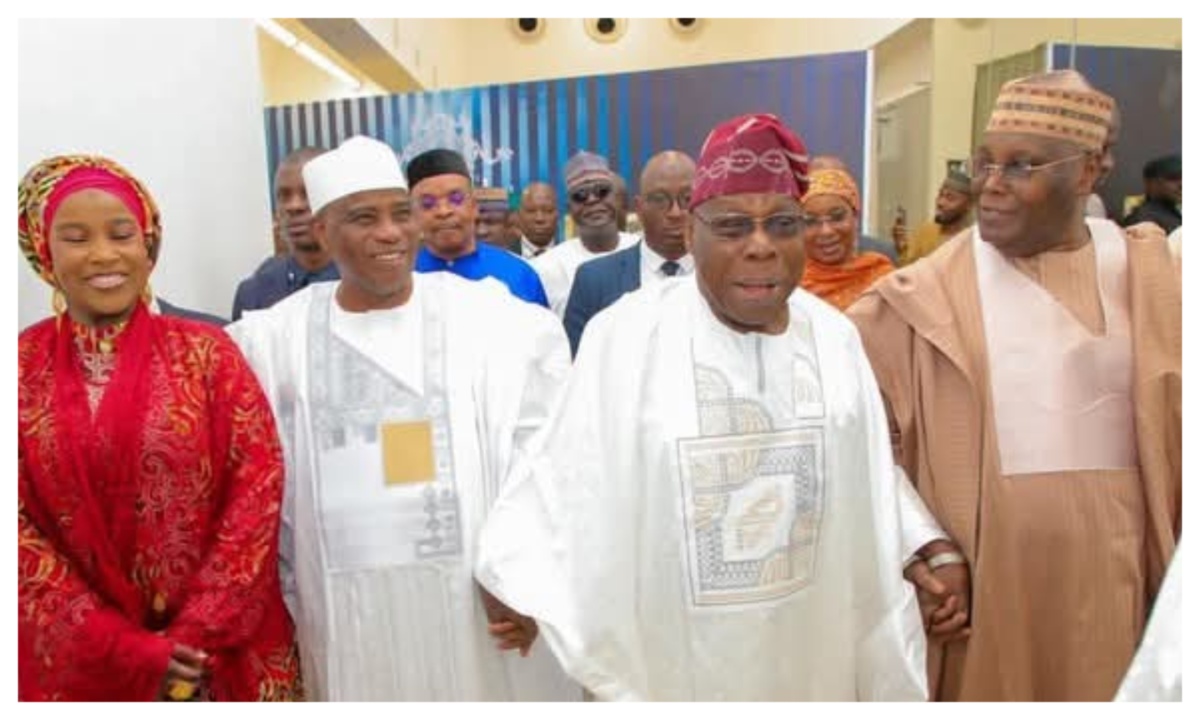
In a rare moment of political retrospection, former President Olusegun Obasanjo has shed light on the executive power play that unsuccessfully sought to block Aminu Waziri Tambuwal from becoming the Speaker of the House of Representatives in 2011. Speaking on Saturday during a leadership colloquium to mark Tambuwal’s 60th birthday, the elder statesman revealed that his opposition, shared by then-President Goodluck Jonathan, was not a personal vendetta but a move dictated by the Peoples Democratic Party’s internal zoning arrangement and a desire for gender inclusivity.
Obasanjo explained that the party hierarchy at the time was fully committed to the candidacy of Mulikat Akande-Adeola, a female lawmaker representing a constituency in the South-West. He noted that the leadership felt that installing the first female Speaker would have been a landmark achievement for Nigerian democracy. According to him, the executive’s stance was rooted in the belief that such a milestone should be protected and encouraged, rather than being sacrificed for the ambitions of the North-West caucus.
However, the political landscape of 2011 was defined by a surge in legislative independence that the executive arm had not fully anticipated. Tambuwal, who was then serving as the Deputy Chief Whip, defied the PDP’s official directive and entered the race with a formidable coalition of lawmakers from both the ruling and opposition parties. The election proved to be a landslide, as Tambuwal secured 252 votes to Akande-Adeola’s 90, effectively signaling the end of the era where the President’s preference was an absolute decree for the National Assembly.
Reflecting on that defiance, Obasanjo admitted that while the executive was initially disappointed, they eventually embraced the reality of the legislature’s choice. He noted that the independence shown by the members was a sign of a maturing democracy. The former President took the opportunity to praise Tambuwal’s character, remarking that his rise to power was tempered by a profound humility. He told the audience that greatness devoid of humility is hollow, but that Tambuwal’s career has shown substance and genuine leadership quality.
Goodluck Jonathan, who joined the event via a virtual link, echoed Obasanjo’s sentiments, acknowledging that his presidency was often at odds with the House under Tambuwal’s leadership. He admitted that while they had several policy and political disagreements, he could not deny the former Speaker’s ability to command the loyalty of his colleagues. Jonathan praised the Senator’s knack for holding a diverse and often unruly House together, a quality the former President said he grew to respect despite their friction.
The event also featured candid admissions from other political heavyweights of the era. Former Senate President David Mark revealed that he had been under immense pressure from the PDP leadership to help subvert Tambuwal’s bid. In a moment of humor that drew laughter from the crowd, Mark confessed that he chose to ignore the President’s directive on the eve of the election to support his “sons,” referring to Tambuwal and his deputy. He noted that the bond within the legislature eventually trumped the dictates of the party secretariat.
The colloquium served as a gathering point for a “who’s who” of Nigerian politics, crossing the usual partisan divides. Former Vice President Atiku Abubakar described the celebrant as a leader whose full potential is yet to be realized, while Peter Obi hailed him as a bridge-builder who prioritizes national unity over ethnic or religious sentiment. Even Adams Oshiomhole, a frequent critic of the PDP era, commended Tambuwal’s dexterity in managing a politically fragmented chamber during a period of intense national tension.
For his part, Tambuwal used the occasion to issue a somber warning about the current state of the Nigerian nation. Now a Senator representing Sokoto South, he argued that the country is currently at a critical crossroads and requires a total rescue from years of systemic rot. He lamented that the practice of imposing unworthy successors on the people has continued to weaken democratic institutions and erode public trust in the government.
Tambuwal stressed that any meaningful national recovery must begin with an honest admission that the system is fundamentally broken. He urged the political class to rise above personal ambitions and partisan interests to focus on genuine reform. According to the former Governor, Nigeria’s future depends on the ability of its leaders to build consensus and uphold justice, rather than simply maintaining power through coercion or patronage.
The presence of Mulikat Akande-Adeola at the event added a final touch of reconciliation to the proceedings. She dismissed any talk of lingering animosity over the 2011 election, stating that only what God wills comes to pass. Her graceful presence served as a reminder of the shifting tides of political fortune and the importance of maintaining relationships beyond the heat of electoral battles.


