
NEWS
IGP Refutes Claims of Arresting Peaceful Ekpoma Protesters
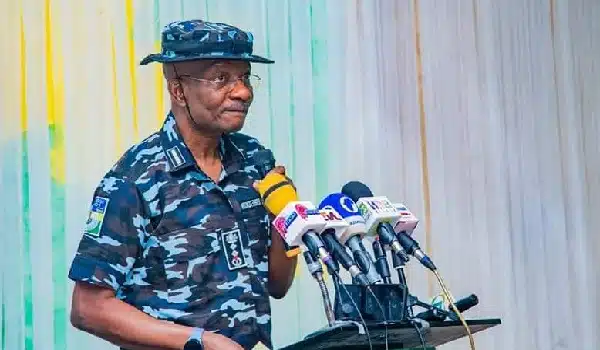
Inspector-General of Police Kayode Egbetokun has stepped forward to challenge the prevailing narrative surrounding the arrest of dozens of individuals in Ekpoma, Edo State. Addressing the controversy during a recent media appearance, the police chief insisted that the 52 suspects currently in custody were not detained for exercising their right to assembly. Instead, he categorized them as criminal elements who exploited a public demonstration to unleash a wave of violence, looting, and destruction across the community.
The arrests, which took place following a massive protest against the surge of kidnappings in the Esan West Local Government Area, have become a flashpoint for public debate. Many of those detained are students of Ambrose Alli University, a fact that has amplified the outcry from parents and civil rights groups. However, Egbetokun dismissed these concerns as part of a “usual false narrative” designed to paint the police as an oppressive force. He argued that the public often overlooks the criminality that occurs under the guise of civic activism.
According to the IGP, the report on his desk tells a far more chaotic story than what has been portrayed in the media. He specifically cited the looting of private businesses and the vandalism of the palace of the Enogie of Ekpoma as the primary reasons for the police intervention. For the police chief, the distinction between a protester and a perpetrator of violence is clear, and he maintains that his officers acted only when the line was crossed into blatant illegality.
The situation took a more serious legal turn when an Edo State High Court sitting in Benin City remanded the suspects at the Ubiaja Prisons. This judicial move intensified accusations that the state was clamping down on dissent. Critics argued that the remand of students alongside hardened criminals was a heavy-handed response to a community crying out for security. Egbetokun, however, remains unmoved by these accusations, lamenting that even when police stations are razed and officers are murdered during protests, the public still blames the force for making arrests.
He was quick to emphasize that the Nigeria Police Force is not an enemy of the people’s right to demonstrate. He reiterated that peaceful protests do not pose a challenge to the police and that officers are actually mandated to protect citizens who march lawfully. The IGP’s stance is that if a group intends to voice grievances without breaking the law, the police have no reason to interfere. He offered a guarantee that lawful demonstrators have nothing to fear from his men, provided their actions remain within the boundaries of the constitution.
The backdrop of this entire saga is the deteriorating security situation in Ekpoma and neighboring towns. Residents, tired of the constant threat of kidnapping, had taken to the streets on January 10 to demand government action. What started as a march with placards ended in a confrontation that the police say turned into an “armed robbery and malicious damage” spree. This transition from a security protest to a public disturbance is the central point of contention between the authorities and the local community.
The political dimension of the case became evident when the Edo State Government intervened following the mounting public pressure. Governor Monday Okpebholo eventually ordered the release of the Ambrose Alli University students among the group, a move that brought immediate relief to the university community. While this executive intervention de-escalated the immediate tension, it has not silenced the broader debate regarding how the police distinguish between genuine protesters and hoodlums in the heat of a crisis.
Egbetokun’s firm “debunking” of the narrative reflects a growing frustration within the police leadership over public perception. He pointed out that the narrative of “arresting peaceful protesters” has become a reflexive response in Nigeria, regardless of the evidence of violence. By speaking out on the Ekpoma incident, the IGP is attempting to reclaim the narrative, insisting that the force is a shield for the law-abiding and a sword against those who use the cover of a crowd to commit crimes.
As the legal proceedings continue for the remaining suspects, the incident serves as a stark reminder of the fragile balance between civil liberties and public order in Nigeria. The IGP’s comments suggest that while the police are willing to facilitate protests, they will not hesitate to use the full weight of the law against any deviation into violence. For the people of Ekpoma, the focus remains on the original cause of the unrest: a desperate need for safety in a region plagued by insecurity.

