
NEWS
Akpabio Invokes World History to Defend Tinubu Partnership
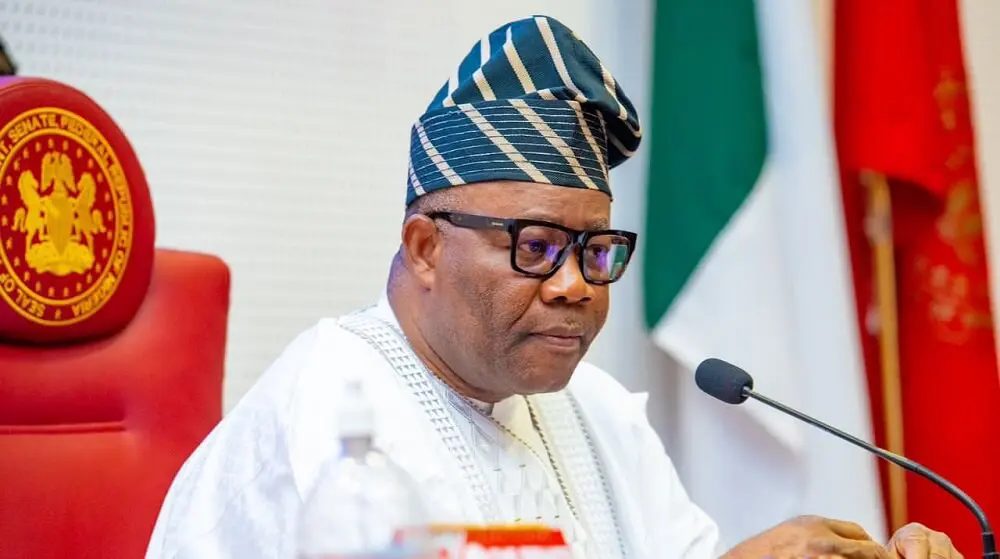
In a rousing defense of the legislative-executive alliance, Senate President Godswill Akpabio on Friday reached deep into the annals of global history to justify the cooperative stance of the 10th National Assembly. Speaking at the joint session for the presentation of the N58.18 trillion 2026 Appropriation Bill by President Bola Ahmed Tinubu, Akpabio dismissed accusations that the parliament had become a “rubber stamp,” arguing instead that stability is the only path to national recovery.
Addressing critics who have labeled the harmonious relationship between the two arms of government as a “sell-out,” Akpabio asserted that progress is never born from perpetual friction. He noted that the most significant advancements in human history occurred when the legislature and executive acted as partners under a common constitutional interest. To bolster his point, he cited the United States under Franklin D. Roosevelt, where the “New Deal” reforms that rescued America from the Great Depression were only possible through intense institutional cooperation.
The Senate President further referenced the rebuilding of post-war Britain under Clement Attlee, highlighting how the establishment of the National Health Service was a product of a parliament and government moving in unison. “In each case, progress flowed not from unanimity of opinion, but from institutional cooperation anchored in a common national interest,” Akpabio stated, suggesting that great nations are forged by leaders who choose to make difficult decisions together.
By contrast, Akpabio painted a grim picture of the alternative, citing the collapse of the Roman Republic as a cautionary tale of how power struggles can paralyze governance. He also pointed to contemporary government shutdowns in the United States as modern examples of how budgetary deadlocks disrupt public services and stifle economic growth. His message was clear: when the organs of the state treat each other as adversaries, it is the ordinary citizen who pays the price.
Defending the performance of the 10th Senate, Akpabio claimed the chamber has achieved one of the highest levels of legislative output in Nigeria’s democratic history. He touted a record number of bills passed over the last year, covering vital sectors such as security, judicial administration, and electoral integrity. According to him, these laws were not just additions to the statute books but were designed to translate reform intent into enforceable policy.
The Senate President specifically highlighted security legislation aimed at enhancing intelligence sharing and economic bills that provided the legal framework for subsidy rationalization. He argued that these reforms have successfully stabilized governance and provided the “legal scaffolding” necessary for long-term prosperity. He insisted that the current synergy is what allows for the rapid mobilization of revenue and the modernization of court administrations.
Despite the optimistic tone regarding policy, Akpabio acknowledged the harsh realities facing many Nigerians. He conceded that the “tangible prosperity” promised by these reforms has yet to reach many households currently struggling with high inflation, unemployment, and the persistent threat of insecurity. He stressed that the lawmakers do not view security-related deaths as mere statistics, but as personal losses affecting their direct constituents.
Looking ahead to the 2026 fiscal year, Akpabio reaffirmed the National Assembly’s commitment to strengthening its oversight functions to ensure that the massive budget translates into real-world relief. He urged Nigerians to remain patient and supportive of the Tinubu administration’s reform agenda, promising that the 10th Assembly would continue to serve with “dedication and resolve” to ensure that the current partnership yields a better quality of life for all.
The session ended with an assurance that the legislature would treat the 2026 budget with the urgency it deserves. By framing the current political climate through the lens of historical success, Akpabio attempted to redefine the narrative of the 10th Assembly—from one of subservience to one of strategic, history-making collaboration intended to pull Nigeria back from the brink of economic stagnation.


