
NEWS
From Power to Prison: Inside the Deepening Ordeal of Abubakar Malami
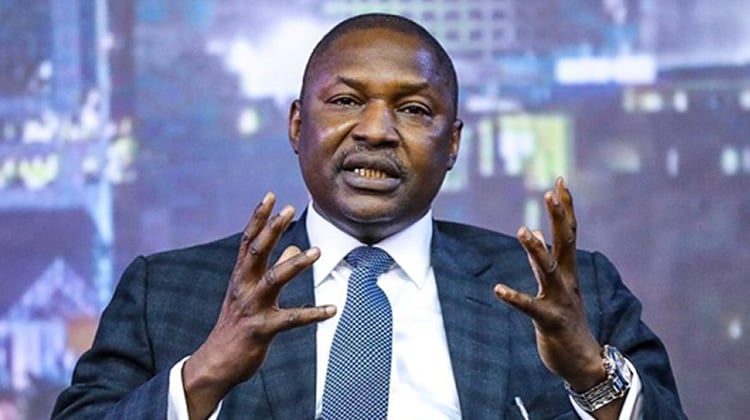
The legal landscape in Nigeria has been rocked by the dramatic rearrest of the former Attorney-General of the Federation and Minister of Justice, Abubakar Malami (SAN). In a scene that felt like a scripted thriller, Malami was intercepted by operatives of the Department of State Services (DSS) just moments after breathing the air of freedom outside the Kuje Correctional Centre. Having finally perfected his bail conditions following an intensive prosecution by the Economic and Financial Crimes Commission (EFCC), the former chief law officer now finds himself entangled in a far more grave web of allegations.
Reliable security sources indicate that this latest detention is not a brief administrative stop. The DSS is reportedly preparing to approach the court for an order to hold Malami for an extended period, potentially spanning months. The justification for this move lies in what investigators describe as the “sensitive and complex” nature of the new charges, which have shifted from financial impropriety to the high-stakes realm of national security and counter-terrorism.
The transition from an EFCC investigation to a DSS probe marks a significant escalation in Malami’s legal woes. While the anti-graft agency focused on a ₦8.7 billion money laundering case involving his wife and son, the secret police are now grilling him on his conduct during his tenure as the nation’s legal arbiter. Central to this inquiry is the controversial handling of the terrorism financing dossiers, specifically those shared by international partners during his time in office.
In 2021, the United Arab Emirates (UAE) sent shockwaves through the Nigerian political establishment by naming six Nigerians as financiers of the Boko Haram insurgent group. At the time, Malami was the face of the government’s response, repeatedly assuring the public that no one would be shielded from justice. Now, investigators are turning the lens back on him, questioning why decisive action was seemingly delayed and how the intelligence provided by foreign authorities was managed behind closed doors.
Beyond the paper trail of international intelligence, the investigation has taken a more visceral turn with reports of a discovered arms cache. Sources within the security apparatus claim that a significant quantity of weapons was allegedly found at Malami’s private residence in Kebbi State. If proven, this discovery would transform the narrative from administrative negligence to direct involvement in activities that threaten the stability of the Nigerian state.
The irony of the situation is not lost on observers. For eight years, Malami was the architect of Nigeria’s legal battles against insurgents and corrupt officials. He famously declared that the “government of the day” would never turn a blind eye to terrorism. Today, those very words are being cited by security officials as they justify why even a former minister of his stature must face the full rigor of the law. The DSS maintains that “inter-agency cooperation” is standard practice, and the gravity of terrorism financing requires a level of scrutiny that transcends political status.
The legal journey for Malami began in early December 2025, when he was first detained over allegations of using corporate entities and high-value real estate to conceal proceeds of crime. Despite a Federal High Court granting him bail in the sum of ₦500 million with stringent conditions, his release was short-lived. The “revolving door” of Nigerian detention facilities has now placed him in the custody of the one agency specifically tasked with protecting the state against internal threats.
As the probe deepens, the implications for the Nigerian political class are immense. This is no longer just a story of alleged financial corruption; it is an investigation into the very heart of how Nigeria managed its fight against terror. The DSS is reportedly vetting multiple petitions that have surfaced since Malami lost his immunity of office, many of which allege that the former AGF’s actions—or lack thereof—provided a shield for those who funded violence across the country.
For now, the man who once held the keys to the Nigerian justice system remains behind bars, facing a team of investigators who are determined to peel back the layers of his eight-year tenure. With the DSS seeking judicial approval for a long-term hold, it appears the “complex” nature of this case will keep Abubakar Malami in the headlines and in custody for the foreseeable future. The transition from the prosecutor’s chair to the suspect’s cell is nearly complete, as the nation watches to see if the law he once administered will now be his undoing.